From Corporate Hustle to Financial Freedom on a Farm

Somewhere between the 9 AM stand-up call and the 9 PM urgent email, a quiet thought crosses the mind of many Indian corporate professionals. It is the dream of trading spreadsheets for soil, boardrooms for open fields and appraisal cycles for harvest seasons isn’t new.
There has been a quiet shift in the mindset of some professionals and the courage to do what they want. In the last few years, the idea of taking up farming and relying on farm income has stopped being a retirement fantasy. It has started to become a reality and also a serious goal to do farming seriously and also earn from it. The journey from corporate hustle to financial freedom on a farm isn’t about romanticising rural life but it is restructuring your relationship with life, money, time and work.
This is not a story about running away from the hustle and bustle of a corporate life and the city you live in. It is about a story about running toward something with a plan. In this blog, let us take a look at the reasons why people take up farming after working for years in a corporate set up.
The Corporate Hustle Trap
Though a corporate life looks glamorous from the outside, many find it mundane and feel less motivated to work even though they are paid high salaries. For them, high salaries don’t always mean freedom.
On paper, a well-paying job looks like success but in practice, many professionals find themselves trapped in what’s often called the “golden handcuffs”. It means a lifestyle so tightly linked to high salary and leaving the job feels impossible, even when the job itself is unsustainable.
A Few Reasons This Trap Tightens Over Time
Lifestyle inflation is one of the reasons for feeling that trap. When income rises, people tend to spend more as they do not know what to do with their disposable income. They go on to take loans with bigger EMIs, buy only premium subscriptions, frequently upgrading their electronic items and wardrobe, leaving little room to actually build wealth.
When people earn a lot of money they tend to spend a lot of time in the office. As a result they are devoid of time. They have very little time to spend the money they earn because of long hours and constant connectivity.
Burnout has become normal and it is being experienced by many on a day-to-day basis. It is no more a warning sign. People have started to accept it as part of their work life and this leads to constant stress. This takes a toll on their long-term health when they keep ignoring it. Companies also treat exhaustion as normal, leading to declining well-being and performance. This mindset harms both employees and the workplace culture.
It may sound like a paradox but the harder you hustle to earn more, the more often you need to earn just to maintain the hustle. Breaking this cycle requires more than a pay hike because you must know your wants and needs clearly and know when to say enough instead of consuming impulsively.
What Does “Financial Freedom” Actually Mean?
Financial freedom is a phase in your life where your money works for you rather than the other way round. You don’t have to live paycheck to paycheck so that you can maintain your lifestyle.
It is not necessary that financial freedom means the same for everyone. It may mean different things to different people based on your financial standing right now.
In the Indian context, financial freedom isn’t necessarily about hitting a specific net worth number. It is about reaching a point where your essential expenses are covered by passive income or investment returns, not by active employment. This could mean rental income from residential property, commercial property and land. Even dividend and interest income from equity, mutual funds and bonds.
The important thing to keep in mind is the shift in your mindset. Freedom is not about never working again but working when you want it and choosing to work. Not because you do not have any other choice.
The Rising Appeal of Agri-Based Income and Independence
Of all the paths to financial independence, why does farmland specifically appeal to so many corporate professionals?
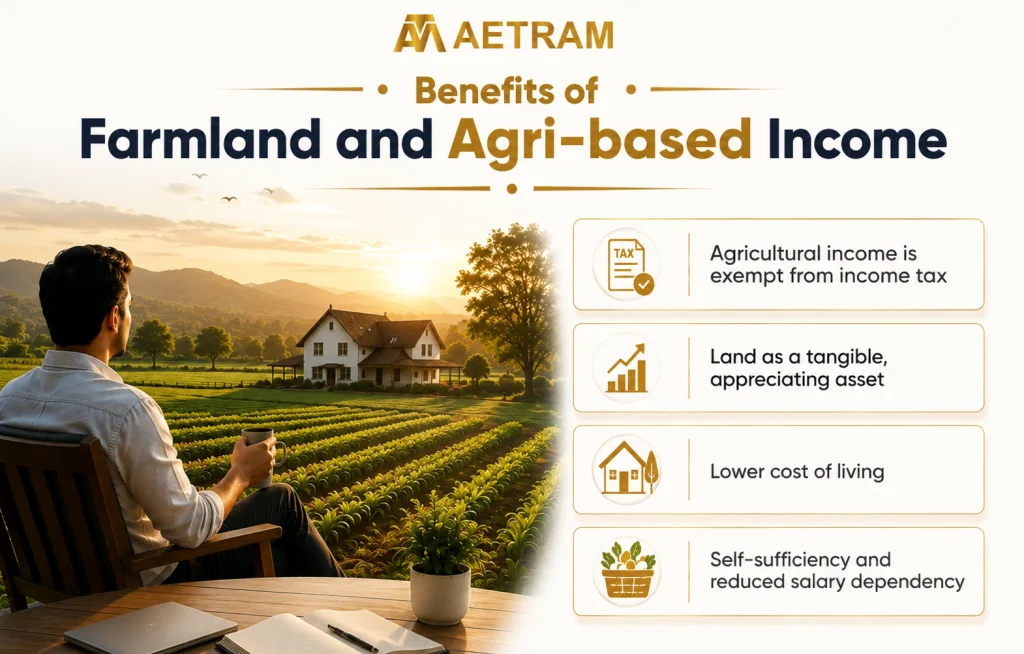
1. Land as a tangible, appreciating asset
Many people depend on agriculture and India has a lot of arable land. Agricultural land in India has historically offered steady long-term appreciation, especially in peri-urban and semi-rural belts where infrastructure is expanding. They can also be used to produce some agri-based products and sell it.
2. Lower cost of living
Rural and semi-rural living dramatically cuts costs on housing, food, and lifestyle expenses which are the three biggest line items in most urban budgets.
3. Self-sufficiency and reduced income dependency
Growing your own food, and potentially generating agricultural income, reduces the amount of passive income you actually need to sustain your lifestyle. This lowers the financial independence “number” considerably compared to staying in a metro.
4. Mental health and lifestyle design
Beyond the numbers, there’s a well-documented correlation between time outdoors, physical activity, and reduced chronic stress which is something most corporate roles actively work against.
Farms don’t just offer an asset class. They offer a completely different cost structure and pace of life.
The Financial Roadmap: How to Actually Get There
Though farming can be rewarding, if you don’t have a financial plan and do not know what to do with farm land then your dreams can turn into debt. Having only ideas and romanticising about it will not yield you any results. Here’s a realistic roadmap.
- Build your corpus before you leap
- Don’t quit first and plan later. Before making any move.
- Build a 12–24 month emergency fund in liquid instruments
- Continue maximising tax-advantaged investments (EPF, PPF, ELSS) while employed
- Clear high-interest debt completely before transitioning
Diversify Your Income Streams
If you want financial freedom, you must not depend on a single source of income. You need a resilient portfolio for this transition and it will typically include:
- Investing in stocks and/or mutual fund investments for long-term growth.
- Fixed income instruments (bonds, debt funds) for stability.
- Farm or agri-business income, once you start producing.
- Side income from freelancing, consulting, content creation, etc. is especially useful during the transition phase because farm income is rarely immediate.
Understand Land Investment Risks in India
In India, owning land is a complex process and owning agricultural land does not guarantee any win or financial success. Key risks to research before buying:
- Title and legal clarity – Verify land records, encumbrance certificates, and conversion status.
- Water availability – Borewell depth, rainfall patterns, and irrigation access make or break farm viability.
- State-specific land laws – Several states restrict agricultural land purchase by non-farmers; this varies widely and needs legal verification.
- Realistic yield expectations – First-time farm income is almost never as high as projected in the first few years.
Real Costs of Rural/Farm Living Most People Don’t Talk About
- Blogs and reels often show the beautiful side of farm life like sunrise views, fresh produce, quiet mornings. What they rarely show:
- Fencing, borewells, farmhouse construction, equipment is often underestimated by lakhs
- Quality medical facilities may be significantly farther away than in urban areas
- Market access for produce can be difficult because without a clear buyer or supply chain, agricultural income can be unpredictable
- Farming is a skill and not a hobby. The learning curve has real financial consequences in the early years
None of this means the dream isn’t achievable. It means it needs to be budgeted for, not assumed away.
Common Mistakes People Make When Chasing This Dream
- Quitting the job before the income bridge is built. Leaving too early forces premature reliance on unproven farm income
- Underestimating the ROI timeline. Most agricultural investments take 3–5 years to show meaningful returns
- Ignoring liquidity is a bad way to go about it. Lcking most of your net worth into illiquid land leaves little room for emergencies
- Treating it as an all-or-nothing decision. The transition doesn’t have to be binary or immediate
Testing the Waters Before You Commit
If you are interested in farming, you do not have to start it immediately in the near future by selling your city apartment and moving to a village. A phased approach reduces risk significantly:
- You can try farming on the weekends. You may buy, lease or rent a small piece of agricultural land close to the city you live in and go on weekends to spend time in the farms and learn the nitty-gritties of farming.
- Invest in managed farmland projects or work with an experienced farmer before going solo. By doing so, you will gain some hands-on experience.
- First, create a source of income that is independent of your location such as freelancing, vlogs, blogs, consulting, etc. which can support you no matter where you live.
- Before committing or moving to do farming, spend enough time or more time in the village so that you understand the local culture, what people have been growing in that village, their culture, the type of soil, etc.
This will give you some reality check and lets you validate the financial and lifestyle assumptions you had before making an irreversible decision.
Conclusion
Transitioning from a corporate race to financial independence on a farm is a path that must be a purposeful and well-investigated decision rather than a single step. This is like a career transition, so it calls for the same focus like your corporate career.
Farming is not some escapade from the corporate grind. It is a different kind of responsibility, where it is measured in seasons instead of weeks, months and quarters and in self-sufficiency instead of salary sheets.
Good news is that if the bustle has begun to seem like a cage, then freedom cannot be discovered by working more inside the same framework.
Frequently Asked Questions (FAQs)
How much money do I need to transition from a corporate job to a farm-based lifestyle?
There’s no fixed number as it depends on your current expenses, location, and desired lifestyle. A common approach is calculating your annual essential expenses and building a corpus that generates that amount through passive income.
Is farmland a good investment in India?
Farmland can be a solid long-term asset, particularly in peri-urban areas with infrastructure growth. However, it comes with some risks like legal, water-access, market, liquidity that need thorough due diligence before purchase.
Can I earn a stable income from farming as a beginner?
Rarely in the first few years. Most successful transitions combine farm income with other passive or semi-active income streams during the initial years which is a learning phase.
Do I need to quit my job completely to start this transition?
No. A phased approach like starting with weekend farming, part-time agri-investment, or remote work allows you to test the lifestyle and build income streams before making a full transition.
What state laws should I check before buying agricultural land in India?
Land purchase eligibility for non-farmers varies by state. Some states restrict agricultural land ownership to those already classified as farmers. Always verify current state-specific regulations and land title records before investing.